Every load-in starts with a truck beeping backwards. The tailgate drops. The show rolls out, neatly packed in flight cases, straight to the stage. And then comes the rest. On a pallet.
Boxes of merchandise on a pallet. Soft drinks on a pallet. Programme booklets, print, the backstage catering. Beer on a pallet, though that one is not for us. The show kit itself travels in cases these days, but everything that comes in boxes comes on wood. More than you think. Nobody looks at it. Everybody trips over it.
What is a pallet, exactly?
A pallet is a flat deck of wood, plastic or metal that goods are stacked on, built so forklift or pallet jack forks slide underneath. The idea is simple: do not move a hundred boxes, move one block. Lights and sound travel in flight cases. Everything else, from merch to soft drinks, starts on one of these boards.
A little shovel, literally
The word is older than the thing. Pallet comes from French: palette, a small shovel, from the Latin pala, spade. It turns up in English in the fifteenth century as the name for a flat wooden blade, the kind potters use to smooth clay. Only in 1921, says the Online Etymology Dictionary, does it come to mean a platform for a forklift. And yes, the painter's palette is exactly the same word. The Flemish, who often just say palet, are closer to the origin than they know.
Two men from Greene, New York
The turning point has a date: 7 November 1939. That day George Raymond Sr. and his engineer Bill House, in the village of Greene in upstate New York, are granted two patents. One for a hydraulic hand pallet truck. The other for a pallet with boards on the bottom as well as the top, the so called double faced pallet. The pallet jack and the pallet as we know them, born on the same day, in the same workshop. The Raymond family reportedly never asked a cent in royalties on the pallet. They preferred to make their money on the trucks.
One million for the army
Then the war arrives, and war loves logistics. In the summer of 1941 the US Army tests every conceivable way of moving goods at the Quartermaster depot in Fort Wayne. The forklift and pallet combination wins by a mile. Shortly after, the Quartermaster General orders one million pallets. From then on everything travels palletised: ammunition, tins, blankets. Whatever sits on a pallet goes from quay to hold in a single move.
When the war ended, the US Army left equipment behind all over the world. In Australia that included pallets and forklifts, painted blue. The Australian government turned them into a shared rental pool, the Commonwealth Handling Equipment Pool, and sold it in 1958 to a company called Brambles. By Brambles' own account that was sixty thousand pallets and a thousand machines, and they mainly wanted the cranes and forklifts. Today it is called CHEP, and the blue pallets you see everywhere still owe their colour to that army paint. That is how far one tin goes.
Europe picks 80 by 120
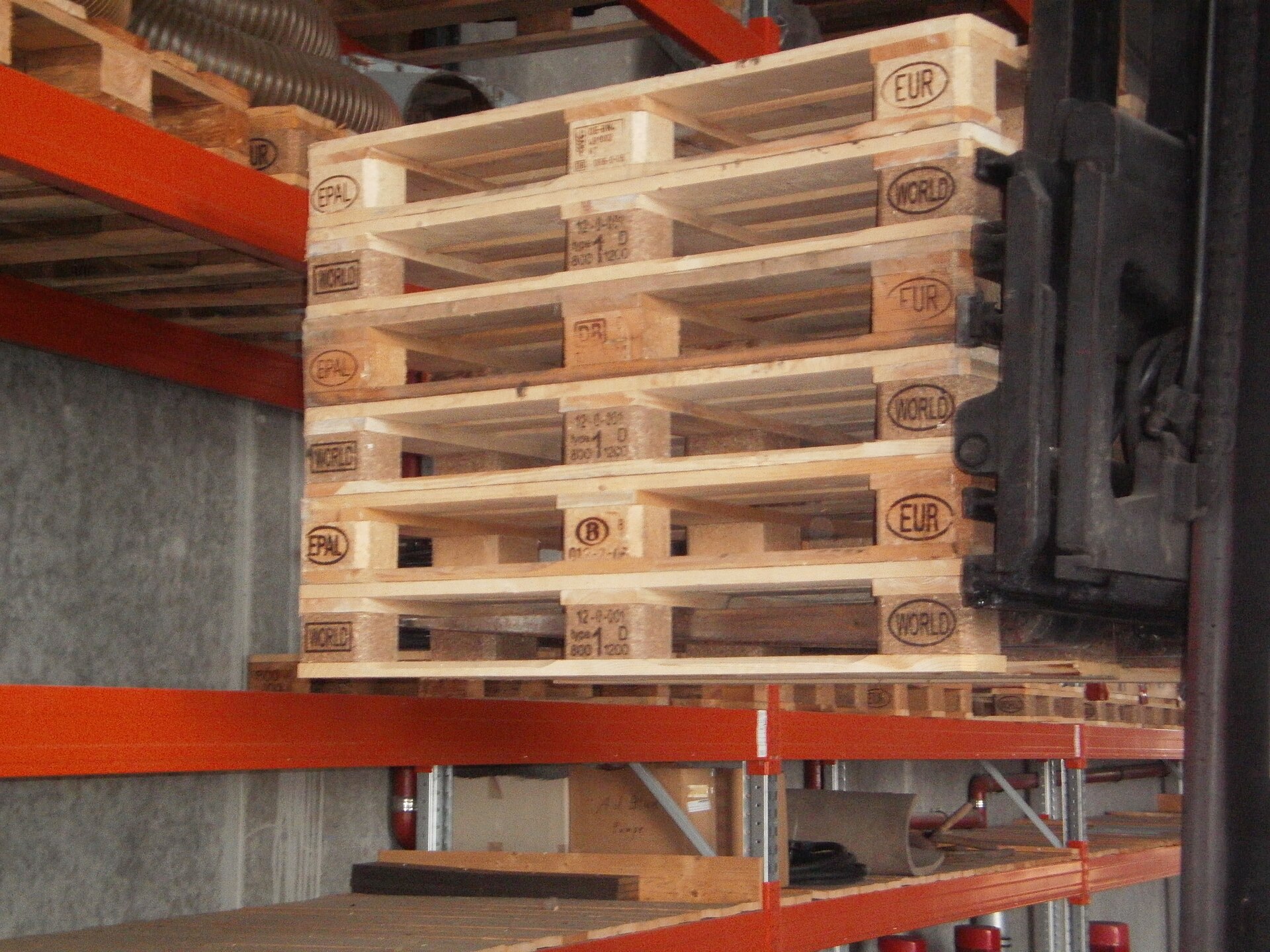
In Europe the story runs on rails. In 1961 the railways, led by the Austrian, German and Swiss operators, set up the European Pallet Pool. One size for everyone: 800 by 1200 millimetres, laid down in UIC leaflet 435-2. And swap instead of buy. Deliver a full pallet, get an empty one back. Since 1991 the European Pallet Association, EPAL for short, has policed the quality and the brand burnt into the blocks.
That brand is not decoration. A genuine Euro pallet is a recipe: eleven boards, nine blocks, 78 nails in a fixed pattern, 144 millimetres high, roughly 25 kilos. Safe working load 1500 kilos. Stacked, it takes up to 4000 kilos on top. According to EPAL itself, more than 650 million of them are in circulation worldwide. In the United States, where they use a different format, the estimate is two billion. That is roughly six pallets per American.
Why the driver is so strict
Anyone who has done a load-out at the Sportpaleis knows the scene. The truck is full, the crew is tired, and the driver is counting pallets. Not to be difficult. A Euro pallet is exchange goods. He delivered twenty, he wants twenty back, or he pays for them himself. A one way pallet, that flimsy thing with the three slats, can stay. A Euro pallet cannot. It is the only piece of packaging on site worth as much as what was sitting on it.
Out on site
Nobody comes to collect a pallet. You come for the fixtures, and those live in a flight case. On wheels, from the truck straight onto the stage, no wood underneath. The pallet is for the rest: the boxes of merch for the stand, the soft drinks for the dressing rooms, the programme booklets for the entrance. A case rolls by itself. A pallet waits for the forklift driver. Read your pallets well and you gain an hour on a build. Use one as a step, a table or a bench and you usually lose one.
And that blue one at the back of the warehouse? That belongs to CHEP. So that one is not yours either.